
Cosmetic Your Ways Blog
Beginner Moisturizer Formulation: Altering the Base Formulation
There are an infinite number of ways to alter this formulation. In this post, I will show you how to modify the various components in the formulation. Based on the base formulation I shared, you can alter the humectants and oils in the oil phase. You have the water phase, the oil phase, and the cool-down phase.
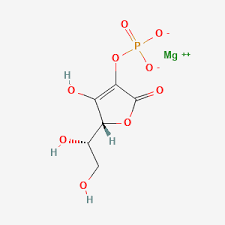
Magnesium Ascorbyl Phosphate (MAP)
I recently got some Magnesium Ascorbyl Phosphate (MAP) from Essential Whole Sale and Labs. This was something I purchased on my own. So, this is not sponsored or anything.
I only have L-Ascorbic Acid, which is not very stable in water. So I wanted the benefits of Vitamin C but a more stable form. I know there is debate on whether the derivatives are worth it. The skin can convert MAP to vitamin C.
Basic and Naturally Compliant Moisturizer
I want to make this formulation as accessible as possible. On Instagram, I created a poll to find out which emulsifiers people had access to. The majority of the people had access to emulsifying wax NF. The one that came in second was Olviem 1000. Olviem 1000 is a blend of Ceteryl Olivate (and) Sorbitan Olivate.
Beginner Moisturizer Formulation
This blog post will be a bit different, as I will be creating a guide rather than a formula to replicate. I want to make this formulation as accessible as possible. On Instagram, I created a poll to find out which emulsifiers people had access to. The majority of the people had access to Emulsifying Wax NF, a blend of Polysorbate 60 (and) Ceteryl Alcohol.
Introduction to Exfoliation Serum
In this post, I will be sharing an exfoliating serum with you that's perfect for the absolute beginner. This will be a beginner formulation for two reasons. Acid products like this, I consider to be intermediate formulations, as pH plays a significant role in their efficacy. Chemical exfoliant products are when chemistry really comes to play. It is all about acids and pH, which is why I do not consider it a beginner's topic. However, I want to empower you to make this serum.
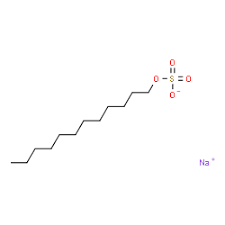
I Bought Sodium Lauryl Sulfate to Formulate with!!!
With the current state of the cosmetic industry, there is a significant amount of misinformation surrounding cosmetic ingredients. Ultimately, they want you to fear other brands so that you will purchase their "clean" product. Based on my experience working with ingredients and obtaining my chemistry degree, all the ingredients that are feared are used for a good reason. To destigmatize this, I want to work with these ingredients. All the ingredients that we use are safe within regulatory limits. I want to show that. People really believe that within one use, you will get cancer, and that is so sad.
What is Happening? High Melting Point, But Cold Process Material?
Thanks Allison for this question,
She wrote, "if an ingredient has a melting point of 296F how the heck can it be used cold process? I’m looking to buy some cholesterol from Making Cosmetics and noticed the melting point was really high. I’ve been digging around trying to find formulations or info and there isn’t much other than a mention on Chemists Corner that it has a high melting point and that the temperature could affect oils it is being melted in. The only other info was on Humblebee’s site where she says it can be used cold process. It isn’t water soluble and has a high melting point so I’m confused. Maybe I just don’t understand the chemistry?!? 😭”
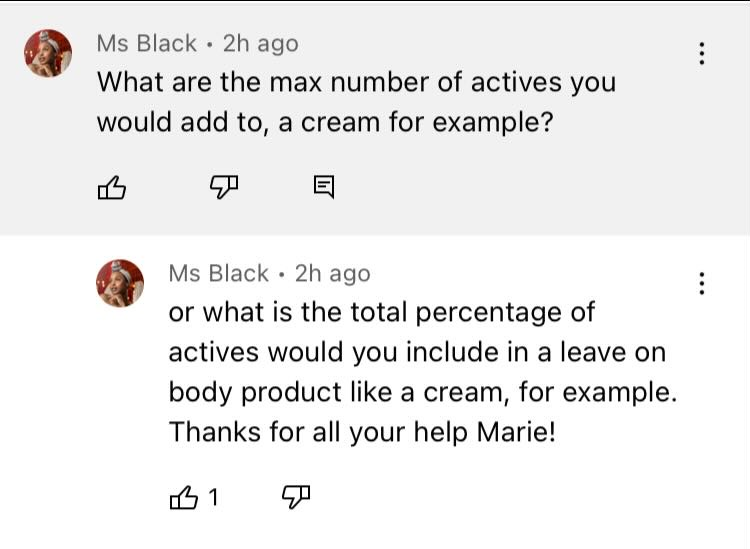
How Many Actives Can We Add?
I found this question on YouTube. I thought that it was an interesting question.
When Should You Use A Chelator?
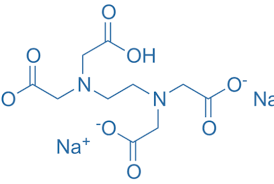
Chelators are underrated, in my opinion. They can help your formula out in more ways than you would think. For a refresher on what chelators are, check out this post (link). In this post, I want to discuss when and when not to use them. This is something I knew about, but did not know how to use until after learning about them in general chemistry. It is coordination chemistry, if you were interested. It is quite interesting for me, but I don't know if you what to learn about it. Let me know in the comments below. I would love your feedback.
Color Correctors
In this post, I will share my color corrector formula. These are oil-based creams that you apply underneath your base makeup to like the name suggests color correct.
Disclaimer:
You are at your own risk when making anything from this blog. I am not liable for any mishaps that may occur. I do my best to include everything in the procedure to minimize the likelihood of accidents. My recommendation is always to read the post entirely first and then make the product.
Please keep in mind that these recipes/formulations are NOT meant to be sold or reproduced in large quantities. None of my recipes has been appropriately stability tested. I recommend seeking professional help if you want to start your own line of business. (link)
Always test a patch of new ingredients before using them.
Comments and opinions written by authors on Cosmetic Your Ways are their own and do not represent the views of any past, present, or future employers.